
Donald Trump shared a video on Truth Social purportedly showing explosions in Isfahan, Iran, following reports of attacks in Tehran. The authenticity of the video is unverified, but reports suggest a joint US-Israeli strike on an ammunition depot.

The launch highlights the growing maturity of India's nuclear medicine ecosystem.
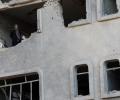
A spokesperson for the Central Khatam al-Anbiya Headquarters said that Iran's armed forces are prepared to intensify their response if aggression continues.

Hiroshima Day is observed on August 6. On that day, the United States B-29 bomber Enola Gay dropped the atomic bomb over the city of Hiroshima on May 6, 1945 changing the course of history.

India and Pakistan exchanged lists of nuclear installations and prisoners, continuing a long-standing practice despite strained relations.

US Vice-President J D Vance's unexpected phone call to Prime Minister Narendra Modi on August 8 has ignited speculation about a potential diplomatic overture, possibly seeking India's support amidst the escalating US-Iran conflict and a shifting global power landscape, suggests Ambassador M K Bhadrakumar.

Dozens of US planes carrying ammunition landed in Tel Aviv, raising concerns about potential strikes on Iran. Negotiations between the US and Iran remain deadlocked over key issues, with both sides issuing fresh demands and warnings.

Donald Trump has escalated rhetoric against Iran by posting AI-generated images and videos depicting US military strikes, warning Tehran that time is running out to secure a ceasefire agreement.

India's nuclear energy share in total installed capacity remains limited, fluctuating between 1.9 per cent and 2.9 per cent from FY10 to FY24.

Gwadar is viewed as a critical pearl in China's maritime strategy as it would give a permanent logistical footprint near an important choke point - the Strait of Hormuz and the oil rich Persian Gulf, explains Commodore Venugopal Menon (retd).

Zolqadr's appointment comes through a presidential decree, endorsed by Supreme Leader Mojtaba Khamenei.

US President Donald Trump on Saturday (local time) said that the United States has launched an attack on three Nuclear sites in Iran.

The US administration has ordered a probe into the deaths and disappearances of at least 10 top US scientists and researchers with access to information related to aerospace, defence and extra-terrestrial life.

'Citizens for a Just Society' stated that BARC was situated on the earthquake zone. In case of any disaster, NWDE would emit nuclear radiations into the environment, which would have harmful effect on the population.

The US-China rapprochement, however tenuous, is not without implications for India. Both China and Pakistan have become closer to the US, notes Ambassador T P Sreenivasan.

'Our diplomacy should have been focused on preventing war and avoiding the inevitable disruptions it would cause, posing a real risk to India's growth story,' asserts former foreign secretary Shyam Saran.

Nobody takes Pakistan seriously and therefore Pakistan's sudden mediating with almost immediate results of a ceasefire seems more contrived than real, points out Vice Admiral Biswajit Dasgupta (retd).

US President Donald Trump on Sunday said that the Israeli strikes on Lebanon's capital of Beirut "should not have happened", warning that such escalation could jeopardise the peace agreement with Iran to achieve a complete solution to the West Asia conflict, which, according to him, is within reach.

The operator's liability in the case of an incident is limited to 3,000 crore for reactors with thermal power above 3,600 Megawatt; 1,500 crore for reactors with thermal power between 1,500 Mw and 3,600 Mw; 750 crore for reactors with thermal power between 750 Mw and 1,500 Mw; 300 crore for reactors with thermal power between 150 Mw and 750 Mw; and 100 crore for reactors having thermal power up to 150 Mw, fuel cycle facilities other than spent fuel reprocessing plants and transportation of nuclear materials.
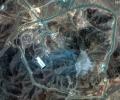
Iran on Sunday vowed to avenge the United States bombing of three of its major nuclear facilities saying the American strikes will have 'everlasting consequences'.

M R Srinivasan focused on the peaceful use of nuclear power at a time when the popular view among the 'hawks' was that India should build a nuclear arsenal as a deterrent.
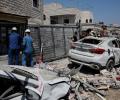
Latest satellite pictures of Iranian military and nuclear facilities released after Israeli strikes show the sites which were damaged after the operation.
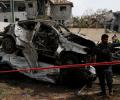
Applauding United States President Donald Trump's 'bold decision' to hit Iran's nuclear facilities, Israeli Prime Minister Benjamin Netanyahu on Sunday said that it demonstrated 'peace through strength' and will lead to a future of peace and prosperity in the region and beyond.

Forty years ago a reactor at the Chernobyl Nuclear Power Plant in Ukraine tore itself apart during a failed test, triggering the worst violent release of radioactive debris into the atmosphere.

China's official media on Sunday criticised United States bomb attacks on Iranian nuclear sites as a further step toward the abyss, while experts in Beijing said the American bunker-buster bombs used in strikes may not be enough to destroy Iran's nuclear plants hidden deep underground.

The United States used an array of weapons in the strikes conducted against Iran as part of Operation Epic Fury on Saturday -- which included artificial intelligence services from Anthropic, according to a report by Reuters.

Odisha-based BonV Aero has partnered with ParaZero Technologies to introduce advanced counter-drone systems to India's defence and security agencies, offering a kinetic solution to neutralise hostile drones.
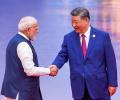
For India, China's Indian Ocean power projection, maritime domain awareness, dual-use ports, underwater surveillance, antisubmarinewarfare, naval exercises with Pakistan, pose considerable pressure, depleted India's strategic depth and marginalises Indian role, points out Srikanth Kondapalli.

As many as 35 vessels, including cargo carriers and oil tankers, successfully navigated through the strategic maritime chokepoint of the Strait of Hormuz over the last 24 hours, according to Iran's state media reports citing a formal declaration by the Islamic Revolutionary Guard Corps (IRGC) Navy.

In a statement released on Friday, the United Nations Atomic Watchdog said it is monitoring the situation very closely.
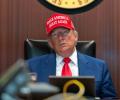
Trump said CNN, along with The New York Times, teamed up to "demean one of the most successful military strikes in history" and termed it "fake news."
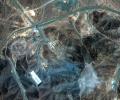
On early Sunday morning, June 22, 2025, the US bombed three nuclear sites in Iran, officially joining Israel's war against the country.

Donald Trump has dismissed the ceasefire with Iran as being on 'massive life support', signalling continued tensions between the US and Iran amid ongoing negotiations.

The Indian government has reduced excise duty on petrol and diesel to mitigate the impact of rising global crude prices, triggered by geopolitical tensions in the Middle East. This move aims to provide relief to consumers and oil companies amidst volatile international oil markets.

A new report highlights India's increasing vulnerability to cyberattacks and CBRN threats due to geopolitical tensions, industrial growth, and urbanisation, calling for an urgent strengthening of its CBRN security strategy through collaboration and investment.

Prime Minister Narendra Modi on Sunday conveyed to Iranian President Masoud Pezeshkian India's 'deep concern' over Iran's conflict with Israel and called for immediate de-escalation of the situation through 'dialogue and diplomacy'.

'Iran cannot trust the USA because it considers the USA to be Israel-controlled. And no, the IRGC is not going to accept anything else but major US concessions.'

United States President Donald Trump has said that Iran is under close watch and a 'massive fleet' is heading towards the Gulf region.

The RusBeam 2800 is now India's largest electron-beam wire deposition 3D printer operating under vacuum. The machine was custom-built for India and is operated with software developed by Rosatom.
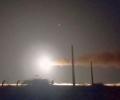
US President Donald Trump maintains that the ceasefire with Iran is still in effect despite recent military engagements near the Strait of Hormuz. He also commented on a recent clash where US forces responded to Iranian attacks on US Navy destroyers.
